Understanding the Reciprocal Rule and Camera Shake

One of the most common reasons a photograph can look soft or blurry is camera shake. This happens when the camera moves slightly while the shutter is open.
A useful rule of thumb for hand-held photography is known as the 1 / Focal Length Rule. It suggests that your shutter speed should be at least as fast as the reciprocal of your lens's focal length.
The Basic Rule
For example:
50mm lens → 1/50s or faster
100mm lens → 1/100s or faster
200mm lens → 1/200s or faster
The reason is simple: the longer the focal length, the more noticeable small movements of the camera become. A slight movement that might be barely noticeable with a wide-angle lens can become much more obvious when using a telephoto lens.
What About Crop-Sensor Cameras?
If you're using a camera with an APS-C sensor, the effective field of view of the lens is narrower than it would be on a full-frame camera. This is often referred to as the crop factor.
For example;
Nikon APS-C cameras have a crop factor of approximately 1.5×
Canon APS-C cameras are generally around 1.6×.
So, a 50mm lens on a Canon APS-C camera has an equivalent field of view of approximately:
50 × 1.6 = 80mm
Using the reciprocal rule, you could therefore use approximately 1/80s or faster as a starting point for hand-held shooting.
The exact approach can vary depending on your camera, lens and technique, but understanding crop factor can help you choose a more appropriate shutter speed.

Doubling Up for Extra Sharpness
The reciprocal rule is a guideline rather than a hard-and-fast rule.
Some photographers prefer to use roughly twice the recommended shutter speed, particularly when working with long lenses or in situations where keeping the camera completely steady is difficult.
For example:
50mm → 1/100s
100mm → 1/200s
200mm → 1/400s
This gives you an extra margin against small movements and can increase your chances of getting a sharp image.
Image Stabilisation Changes the Equation
Modern cameras and lenses may have image stabilisation, sometimes called Optical Image Stabilisation (OIS), Vibration Reduction (VR) or In-Body Image Stabilisation (IBIS).
These systems can compensate for small movements and allow you to hand-hold a camera at shutter speeds considerably slower than the traditional reciprocal rule would suggest.
However, image stabilisation doesn't freeze your subject.
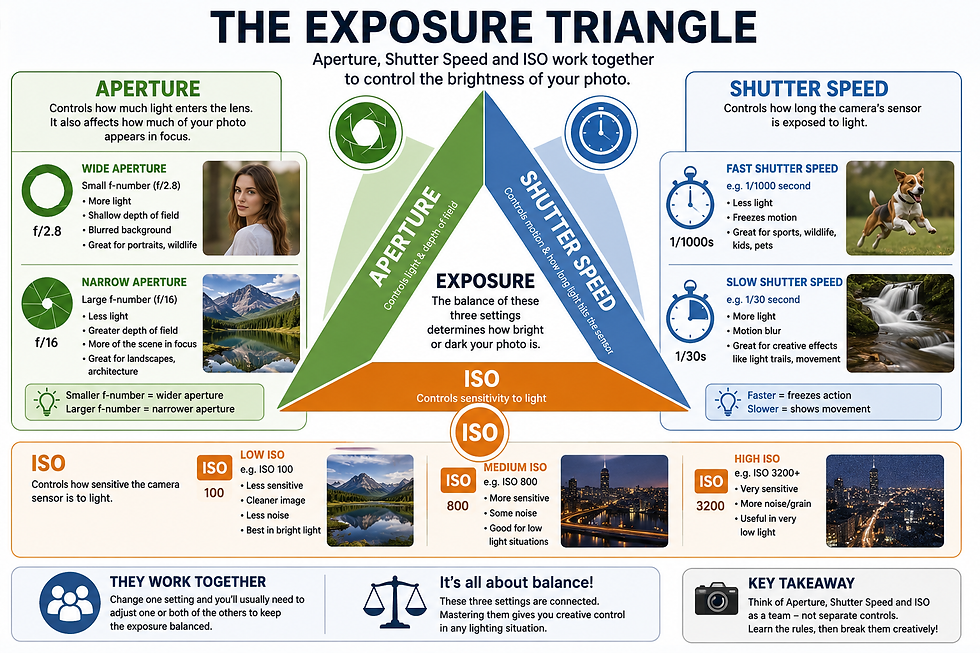
If you're photographing a person walking, a child running, a bird in flight or a sporting event, you may still need a fast shutter speed even if your camera has excellent stabilisation.
Don't Forget Your Own Technique
Your equipment isn't the only factor affecting camera shake.
Holding the camera securely, keeping your elbows close to your body, using a stable stance and gently pressing the shutter can all help reduce movement.
For particularly slow shutter speeds, a tripod provides an even more reliable solution.
The key thing to remember is that the 1 / Focal Length Rule is a starting point, not a strict law. Use it to help choose your shutter speed, then adjust it according to your camera, lens, subject and shooting conditions.
When in doubt, a slightly faster shutter speed is often a small price to pay for a sharper photograph.


Comments