Composition in Photography

The Art of Seeing
A great photograph isn't necessarily about having the most expensive camera, the biggest lens or the highest megapixel count.
Quite often, it's about where you point the camera and what you choose to include in the frame.
That is composition.
Composition is the process of arranging the visual elements within your photograph so that the image becomes balanced, interesting and engaging. It helps guide the viewer's eye, creates a sense of depth and can turn an ordinary scene into something memorable.
And the good news?
Composition costs nothing.
You can use exactly the same camera and lens, stand in exactly the same location and take two completely different photographs simply by changing your composition.

What Is Composition?
Composition is essentially how you organise the elements within your frame.
These elements might include:
People
Buildings
Mountains
Trees
Roads
Rivers
Colours
Shadows
Patterns
Textures
Light and dark areas
Empty space
Before pressing the shutter, ask yourself:
What do I want the viewer to look at?
Then consider how everything else in the frame supports – or distracts from – that subject.
Good composition isn't about following a set of rules blindly. It's about making deliberate decisions.
Why Does Composition Matter?
Imagine photographing a beautiful mountain landscape.
The mountain might be spectacular, but if you have a rubbish bin, a distracting telegraph pole and half a car sticking into the edge of the photograph, the image suddenly becomes much less effective.
The camera records everything.
Your job as the photographer is to decide what deserves to be recorded.
Good composition can:
Direct the eye Lead the viewer towards the main subject.
Create balance Distribute visual weight throughout the photograph.
Add depth Give a two-dimensional image a feeling of three dimensions.
Create emotion A carefully composed image can feel calm, dramatic, lonely, energetic or mysterious.
Tell a story Composition can show relationships between people, objects and their surroundings.
The Rule of Thirds
One of the most familiar composition techniques is the Rule of Thirds.
Imagine dividing your photograph into nine equal sections using two horizontal and two vertical lines.
Instead of placing your subject directly in the centre, try positioning it along one of the lines or, even better, near one of the four intersection points.
This often creates a more natural and visually interesting photograph.
For landscapes, for example, you might position the horizon along the upper third if the foreground is important, or the lower third if the sky is the main attraction.
But don't become obsessed with it!
Centred compositions can be extremely powerful too. The important thing is understanding why you are placing your subject where you are.
Leading Lines
Our eyes naturally follow lines.
Photographers can use this to their advantage.
Roads, paths, fences, rivers, railway tracks, walls and even shadows can become leading lines, directing the viewer's attention towards your main subject.
A winding road disappearing into the mountains can create a strong sense of depth.
A pier stretching into the sea can draw the viewer into the photograph.
Look around your environment and start asking:
"Where do the lines lead?"
Framing
Framing involves using something within the scene to surround or partially surround your subject.
It could be:
An archway
A doorway
A window
Trees
Branches
Buildings
Bridges
Rocks
Framing can help isolate your subject from a busy background while also adding depth to the photograph.
It gives the viewer the feeling that they're looking through something and into the scene.
Balance
Balance is about the distribution of visual weight within your photograph and doesn't necessarily mean symmetry.
A large object on one side of the frame might be balanced by several smaller objects on the other.
Colour can also create visual weight. A small area of bright red, for example, can attract more attention than a much larger area of muted colour.
Think about:
Size • Colour • Contrast • Position • Shape
All of these influence how the photograph feels.
Negative Space
Sometimes, less is more.
Negative space is the empty or relatively uncluttered area surrounding your subject. A lone tree in a huge landscape, a person standing against an empty wall or a boat surrounded by calm water can all make powerful use of negative space.
It can create:
Simplicity
Isolation
Calm
Scale
Drama
Mystery
Don't automatically feel that you have to fill every part of the frame.
Empty space can say just as much as a busy scene.
Think About the Background
One of the easiest ways to improve your photographs is to pay more attention to what's happening behind your subject.
How many times have you taken a photograph of someone only to discover later that a lamp post appears to be growing out of their head?
The subject might be perfect, but the background ruins the photograph and before pressing the shutter, quickly scan the edges and background of your frame.
Ask:
Is anything distracting me?
If it is distracting you, it will probably distract your viewer too.
Change Your Position
One of the most powerful composition tools you have isn't found in your camera.
It's your feet.
Try moving:
Left
Right
Forward
Backwards
Higher
Lower
Get down low.
Shoot from above.
Move closer.
Step further away.
A tiny change in viewpoint can completely alter the relationship between objects in your photograph.
Instead of zooming in immediately, consider physically moving yourself.
Change your position before changing your settings.
Don't Forget Portrait Orientation
We're often taught to photograph landscapes horizontally and portraits vertically.
But these aren't rules.
Try both.
A tall photograph might emphasise the height of a mountain, building or tree.
A horizontal photograph might better capture a person within their environment.
Ask yourself:
Which orientation tells the story better?
Simplicity Is Powerful
One of the most common problems in photography is trying to include too much and when we see something interesting and photograph everything around it.
But sometimes the strongest photograph is the simplest one.
Try removing unnecessary elements from your composition.
Instead of asking:
"What else can I include?"
ask:
"What can I remove?"
This is particularly important in landscape photography.
Composition Before Camera Settings
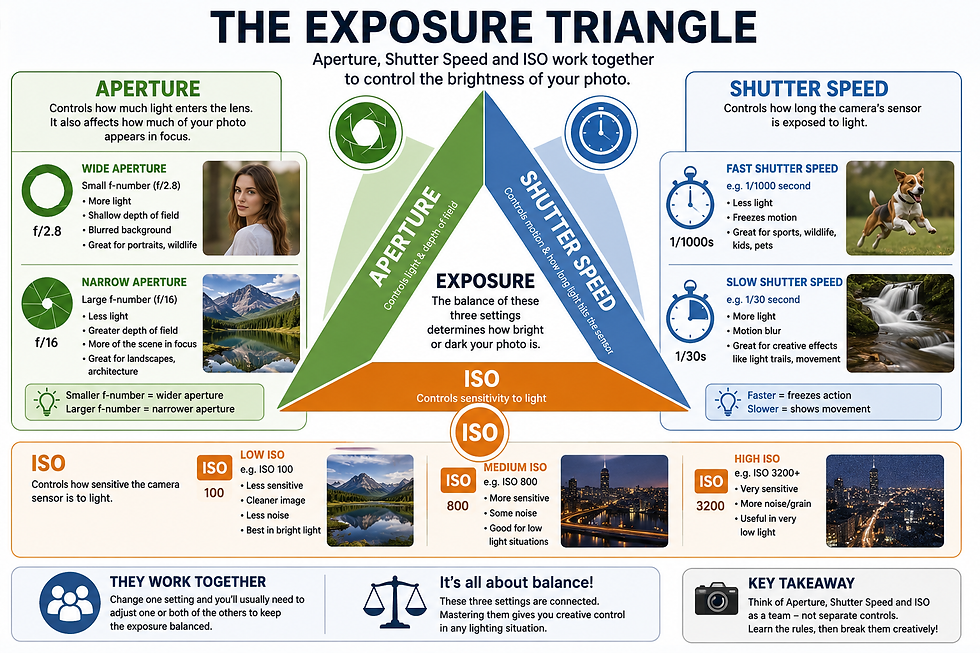
It's easy to become obsessed with aperture, shutter speed and ISO, yes, understanding your camera is important. But technically perfect photographs can still be boring.
A perfectly exposed photograph with poor composition is still a poorly composed photograph.
Before worrying about the settings, think about:
Subject → Position → Background → Light → Composition → Camera Settings
Get the composition right first.
Break the Rules!
The Rule of Thirds, leading lines, framing and negative space are guidelines, not laws.
Once you understand them, experiment.
Put your subject in the centre.
Tilt the camera.
Leave huge amounts of empty space.
Fill the entire frame.
Create deliberate imbalance.
Sometimes breaking a traditional composition rule produces a much stronger photograph.
The important thing is that you know why you're doing it.
A Simple Composition Checklist
Before pressing the shutter, take a few seconds to ask yourself:
1. What is my subject?
What do I want the viewer to notice?
2. Where is it positioned?
Could moving it within the frame improve the image?
3. What's happening in the background?
Are there distractions?
4. Can I use lines?
Roads, paths, rivers, buildings and shadows can all guide the eye.
5. Is the image balanced?
Look at the visual weight across the entire frame.
6. Is there too much going on?
Try simplifying.
7. Would another viewpoint work better?
Move your feet!
8. Should I shoot vertically or horizontally?
Try both if you're unsure.
9. Where is the light?
Composition and light work together.
10. Does the photograph tell the story I want?
If it does, press the shutter.

Practice Makes Composition Instinctive
The more you consciously think about composition, the more natural it becomes. Eventually you will start seeing potential compositions before you even raise the camera.
You'll notice leading lines.
You'll see patterns.
You'll recognise symmetry.
You'll spot opportunities for framing.
You'll become aware of distracting backgrounds.
And you'll start moving instinctively to find the strongest viewpoint.
Photography isn't just about learning how to operate a camera.
It's about learning how to see.


Comments